

Seven Research Outcomes from the Department of Radiation Oncology, Peking University Third Hospital Selected for ASTRO 2025
Exciting News Update came from the Department of Radiation Oncology, Peking University Third Hospital. One research outcome from the Peking University Third Hospital – LinaTech Precision Radiotherapy Joint R&D Center was selected for oral presentation at the Annual Meeting of the Chinese Society for Radiation Oncology, while seven other outcomes were accepted for poster presentation at ASTRO, the top North American industry conference.
The center is dedicated to joint R&D of domestically-owned large-scale equipment for AI-guided precision radiotherapy and exploring optimal modalities of spatially fractionated radiotherapy. The seven outcomes cover: large FOV CBCT system, dosimetric comparison between orthogonal vs parallel dual-layer MLC, exploration of limitations for big data model expansion, dose plan quality evaluation using vision-language models, prostate motion management during treatment with Comfort AutoScan system, deep learning-based 4D tracking of pancreatic tumors, and optimized pancreatic tumor segmentation driven by NCCN guidelines. LinaTech’s orthogonal dual-layer grating and spectral CT technologies supported these studies.
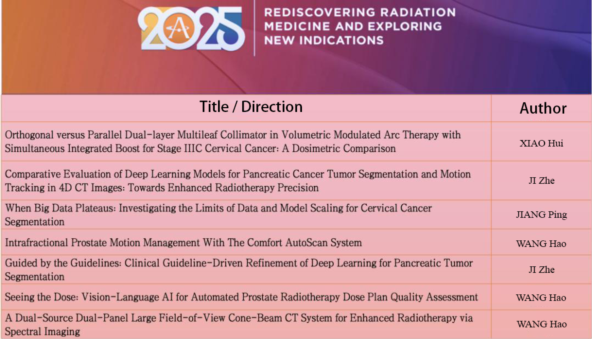
In the first paper mentioned above, the study evaluated dosimetric differences between orthogonal and parallel dual-layer multi-leaf collimators (MLC) in volumetric modulated arc therapy with simultaneous integrated boost (VMAT-SIB) for stage IIIC cervical cancer (FIGO 2018) with lymph node metastasis (LNM). Dosimetric analysis verified both MLC types meet clinical target volume coverage requirements, yet orthogonal MLC delivers better organs-at-risk protection, especially for complex cases with bilateral pelvic lymph node metastasis.
In the latest paper, the research team introduced the VenusCT Dual system equipped with two X-ray sources and two flat-panel detectors. Integrated with spectral CT technology, the system can acquire energy-resolved image data to achieve superior tissue contrast and material differentiation capability. The study mainly assessed system performance across multiple radiotherapy cases, including expanded field of view, improved image quality and potential clinical benefits for radiotherapy precision. It compared advantages in key parameters such as contrast-to-noise ratio (CNR) and dose efficiency under simulated clinical scenarios. Experimental results show the system achieves a field of view (FOV) up to 70 cm, approximately 75% larger than traditional CBCT systems, greatly expanding imaging coverage and enabling complete imaging of large anatomical regions such as the thoracic cavity, facilitating more accurate tumor delineation. In addition, spectral imaging improves soft tissue contrast by roughly 25–30%, enhances contrast-to-noise ratio (CNR), and is expected to reduce imaging dose by about 15%. These technological advances can translate into more precise radiotherapy planning and delivery, ultimately improving treatment outcomes.
Over the past two years, under the leadership of Professor Wang Junjie from the Department of Radiation Oncology, Peking University Third Hospital, LinaTech and Peking University Third Hospital have carried out a series of industry-university-research collaborative innovation projects. These include participation in the Bethune Charitable Foundation “Research & Refinement · Precision Radiotherapy Research Project”, selection for the national key R&D program “Intelligent Robot” project, and establishment of the “Peking University Third Hospital - LinaTech Precision Radiotherapy Joint R&D Center”. Focusing on intelligent and digital precision radiotherapy and CT fields, the two sides tackle key challenges, jointly responding to clinical demands and accelerate the translation of innovative research outcomes.
Radiotherapy has fully entered the era of precision treatment. Leveraging comprehensive strengths in medical care, teaching and research, Peking University Third Hospital continues to deepen integration of clinical practice and research. Taking these selected outcomes as an opportunity, the Department of Radiation Oncology accelerates original innovation in radiotherapy research. It is expected that both sides will further deepen cooperation, give full play to respective advantages of hospital and enterprise, promote advances in China’s radiotherapy technology and improve treatment outcomes for cancer patients.



Recommended Reading
Hotline:+86 10 67888916
Time:8:00 - 18:00